
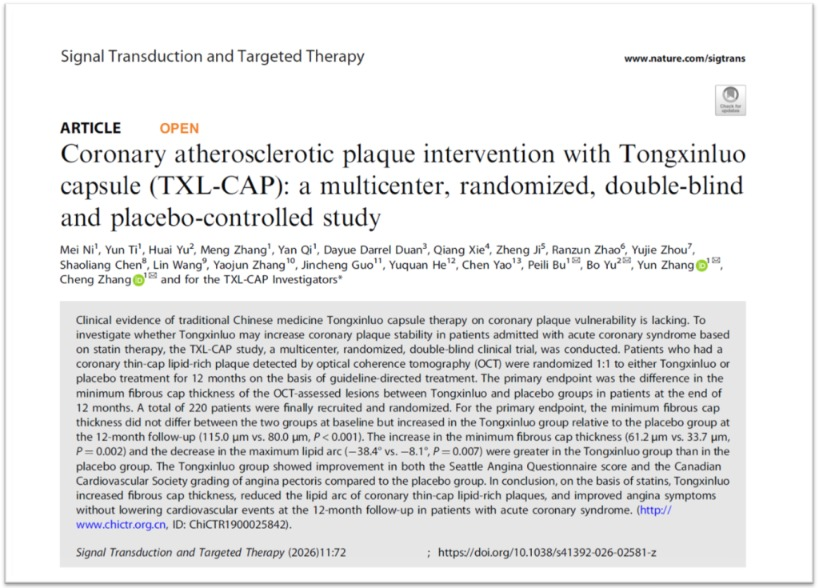
On February 24, the paper titled “Coronary atherosclerotic plaque intervention with Tongxinluo capsule (TXL-CAP): a multicenter, randomized, double-blind and placebo-controlled study” was published online in Signal Transduction and Targeted Therapy (STTT, Impact Factor: 52.7), a leading international academic journal overseen by Springer Nature. The results demonstrated that, when used in combination with modern standard treatments such as statins, Tongxinluo Capsules significantly increased the fibrous cap thickness of coronary vulnerable plaques, reduced the lipid arc of the plaques, and alleviated symptoms of angina pectoris in patients with Acute Coronary Syndrome. This provides an effective therapeutic strategy for stabilizing coronary plaques in clinical practice.
It is understood that Tongxinluo Capsules is an innovative patented traditional Chinese medicine developed by Yiling Pharmaceutical, which has demonstrated significant efficacy in the prevention and treatment of cardiovascular and cerebrovascular diseases. Acute Coronary Syndrome (ACS) is a severe cardiovascular disease that poses a major threat to human health, characterized by high morbidity, high mortality, and high disability rates. This is because the presence of vulnerable plaques within the coronary arteries renders them unstable and prone to rupture. Once ruptured, these plaques can trigger thrombosis, leading to severe consequences such as myocardial infarction or cerebral ischemic stroke. Therefore, even in the current era of widespread implementation of percutaneous coronary intervention and intensive pharmacotherapy, a subset of patients still exhibits significant “residual cardiovascular risk”, and the incidence of long-term major adverse cardiovascular events remains high. How to further reduce residual risk on the basis of modern standard treatment represents a major challenge in the current prevention and treatment of coronary heart disease.
The “Coronary atherosclerotic plaque intervention with Tongxinluo capsule (TXL-CAP): a multicenter, randomized, double-blind and placebo-controlled study” is a sub-project of the National Key R&D Program titled “Systematic Intervention of the Cardiovascular Continuum by Venation and Ying-wei Theory”. This study was led by Professor Zhang Cheng (Academician of the Academia Europaea), Academician Zhang Yun, and Professor Bu Peili from Qilu Hospital of Shandong University, as well as Professor Yu Bo’s team from The 2nd Affiliated Hospital of Harbin Medical University. It was jointly completed by 17 Level A Tertiary hospitals nationwide. The study focused on the question: “Based on modern standard Western medical treatment, can Tongxinluo Capsules further stabilize coronary vulnerable plaques?”.
The study team first performed optical coherence tomography (OCT) examinations on 1,607 patients with acute coronary syndrome. From this cohort, 220 patients who met the inclusion criteria were selected and randomly assigned to either the Tongxinluo Capsules group or the control group. All enrolled patients were confirmed by OCT to have coronary unstable plaques (defined as a minimum fibrous cap thickness <100 μm and a lipid arc >90°). All patients received interventional therapy and standard pharmacotherapy as recommended by the guidelines. Approximately 93% of patients in both the Tongxinluo Capsules group and the control group received statins, which fully reflects the “add-on intervention based on modern standard treatment”.
After 12 months of treatment, the results showed that the mean increase in fibrous cap thickness was 61.2 μm in the Tongxinluo Capsules group versus 33.7 μm in the control group, with the former being nearly double that of the latter. Moreover, this effect of Tongxinluo Capsules demonstrated good generalizability, showing consistent results across various subgroups, including different ages, sexes, presence or absence of type 2 diabetes, and types of coronary lesions. Concurrently, the mean reduction in maximum lipid arc of coronary plaques was significantly greater in the Tongxinluo Capsules group (approximately −38°) compared to the control group (approximately −8°). Simply put, increasing the fibrous cap thickness and reducing the lipid arc indicates that the plaque becomes more stable and less prone to rupture. This is analogous to how a dumpling with a thick wrapper and small filling is less likely to break than one with a thin wrapper and large filling. These findings collectively indicate that, on the basis of modern standard treatments such as statins, the addition of Tongxinluo Capsules can further increase fibrous cap thickness and reduce lipid components in vulnerable plaques, thereby remodeling the plaque structure toward a “more stable” phenotype. Additionally, the study found that compared with the control group, patients in the Tongxinluo Capsules group experienced significant improvement in angina symptoms, with a favorable safety profile.
This study represents the first application of the international “gold standard” for evaluating vulnerable plaques—optical coherence tomography (OCT)—using high-resolution coronary OCT imaging as a pivotal approach. For the first time, it provides high-quality imaging evidence that Tongxinluo Capsules stabilizes coronary vulnerable plaques in patients with acute coronary syndrome. Furthermore, the findings offer robust support for the potential mechanism by which Tongxinluo Capsules reduces residual cardiovascular risk in acute coronary syndrome and establish it as an effective therapeutic drug for stabilizing vulnerable plaques and reducing cardiovascular events within the intervention nodes of the cardiovascular continuum. This study is internationally competitive, positioning itself at the forefront of global scientific advancement.
Previously, the study titled “China Tongxinluo Study for Myocardial Protection in Patients with Acute Myocardial Infarction”, led by Professor Yang Yuejin from Fuwai Hospital, CAMS & PUMC, confirmed that in patients with ST-segment elevation myocardial infarction (STEMI) undergoing revascularization and standardized Western medical treatment, continuous administration of Tongxinluo Capsules for 12 months significantly improved both short-term and long-term clinical outcomes and reduced the risk of major adverse cardiovascular events. This provides important clinical evidence supporting the role of Tongxinluo Capsules in improving outcomes for patients with coronary heart disease. The clinical outcome benefits demonstrated in these studies indicate that the application of Tongxinluo Capsules in coronary heart disease, particularly in acute coronary syndrome, has progressively formed a relatively comprehensive evidence-based medical framework. This highlights the unique value and promising application prospects of traditional Chinese medicine in the standardized treatment and comprehensive management of acute coronary syndrome.